Preprint, version 2.0 · August 6, 2026
Mechanistic Tomography
Designed Measurement for Control-Oriented Interpretability
Abstract
Mechanistic interpretability tries to recover quantities a model does not expose directly: represented states, component effects, interactions, and responses to interventions. This paper treats that task as a problem of measurement design. Coordinate patching, attribution patching, subset interventions, Hessian-vector products, and lifted interaction recovery are described through a shared structure: a declared target, a measurement operator, structured error, and validation on held-out interventions.
The resulting procedure starts with the least costly measurements available, tests the recovered map at the intervention scale where it will be used, and expands the measurement family only when residual structure requires it. Control provides the principal validation setting because errors in an estimated mechanism then have a direct operational consequence.
Main contributions
- A common measurement formulation for methods that estimate different internal quantities through different forms of model access.
- Held-out intervention tests that distinguish an explanatory fit from an effect map that can support action.
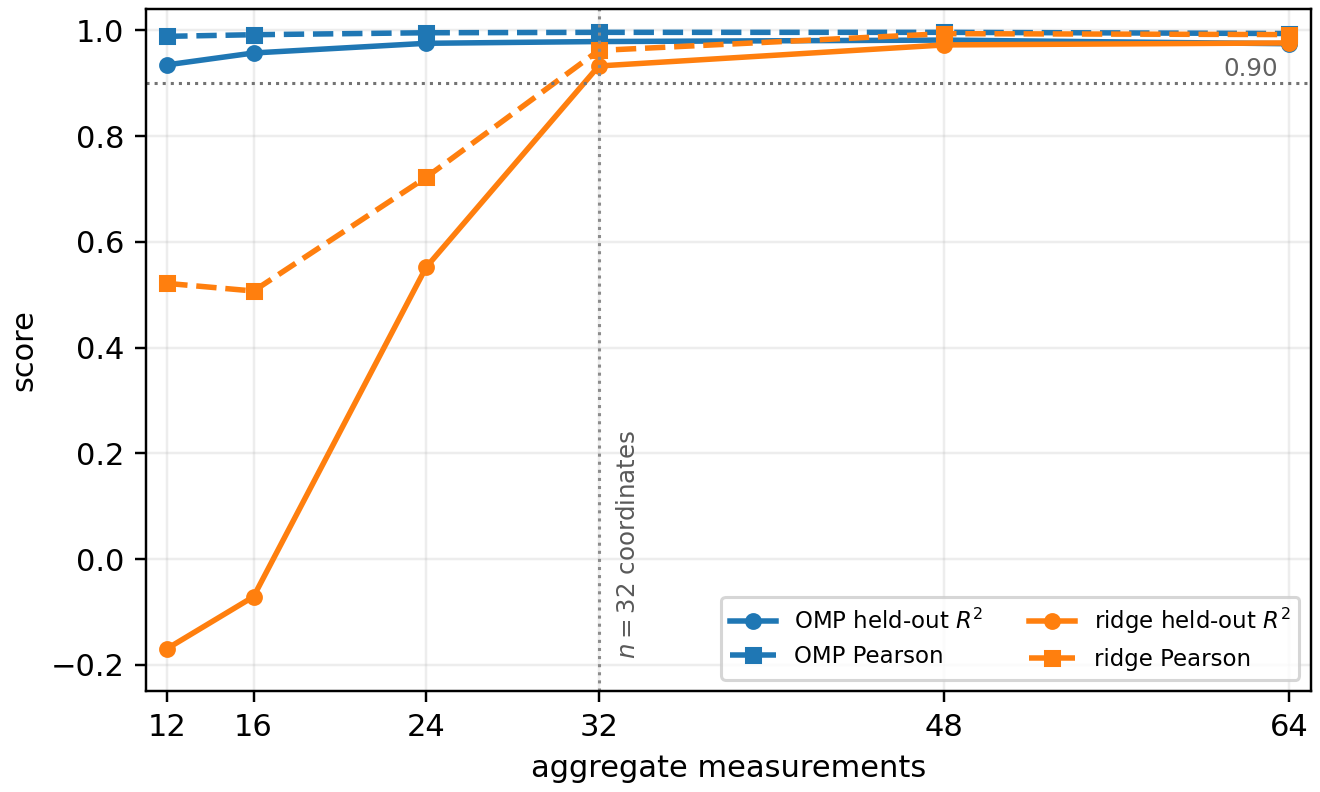
- Sparse aggregate measurements that can recover compressible effect maps with fewer forward interventions than coordinate-by-coordinate probing.
- Calibration and interaction measurements that reveal when local gradients or first-order maps are insufficient at finite intervention scale.
- Experiments spanning a two-HMM control setting, planted sparse effects, Tracr, GPT-2-small on IOI, and a held-out Qwen-2.5-7B response surface.
Measurement procedure
- Declare the target. Specify the effect map, basis, intervention family, and intended use.
- Choose an access path. Use forward probes, gradients, or curvature measurements according to the target and cost.
- Test held-out interventions. Evaluate the map at the scale where it will guide decisions.
- Inspect the residual. Calibrate simple mismatch or add interactions, curvature, or a different basis when needed.
Selected results
On Qwen-2.5-7B, a calibrated additive map predicts a finite refusal-response surface with held-out R² 0.9829. Pairwise lifting does not improve held-out MAE: the estimated relative improvement is −0.29%, with a paired bootstrap 95% interval of [−3.56%, 5.65%]. The result illustrates the framework's stopping rule: use the richer family only when the measured residual requires it.
Code and reproducibility
Version 2 releases all paper experiments, frozen result tables and measurements, the manuscript source, and a public Qwen Colab notebook. The notebook's default path reproduces the Qwen table without loading the model; an optional resumable GPU path reruns the 401-action measurement surface.
Why control?
Identification is not the endpoint. The aim is to recover internal structure well enough to intervene on something downstream: change a model behavior, move a target quantity, or maintain a chosen property near a desired value. Control makes that intent explicit by connecting an estimated mechanism to an action and then measuring the resulting effect.
Once an estimate guides an intervention, it acts as an observer. A useful observer must predict what the intervention will do, not merely reconstruct a mechanism on the data used to fit it. In the two-HMM experiment, the controller and actuator are fixed while the observer varies, exposing how identification error reaches closed-loop error on the property being controlled. The measurement framework itself applies more broadly to internal states and finite intervention effects.
Citation
Version 2.0 is the current public manuscript. Version 1.0 is preserved by Zenodo under a permanent DOI; an arXiv version is forthcoming.
@misc{erramilli2026mechanistic,
  title   = {Mechanistic Tomography: Designed Measurement
             for Control-Oriented Interpretability},
  author  = {Vijay Erramilli},
  year    = {2026},
  version = {2.0},
  url     = {https://kwisatzh.github.io/mechanistic-tomography/},
  note    = {Version 1 archived at doi:10.5281/zenodo.21797578}
}